


Season 2 - Making Parts
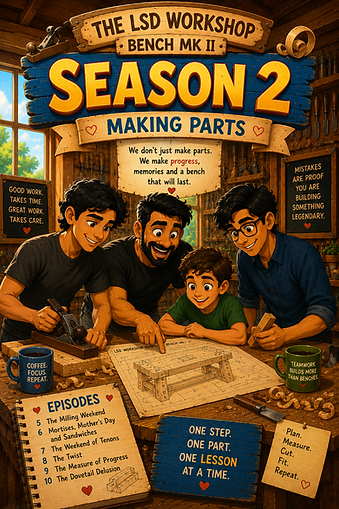
The second season of The LSD Workshop Bench Mk II begins where every serious woodworking project eventually arrives.
Not with inspiration.
With preparation.
The timber had been purchased.
The mistakes had already begun.
The participants had committed.
Now came the work.
The real work.
The kind that rarely appears in highlight reels.
The kind that quietly determines whether a project succeeds or fails.
For five weekends, the workshop became a classroom, a construction site and occasionally a testing facility for human patience.
The first challenge was milling.
Board after board had to be dimensioned, checked and prepared.
The work was repetitive.
The progress was difficult to see.
Yet every accurate mortise and every well-fitting tenon that followed depended entirely on those early hours spent preparing stock.
It was an important lesson. Beautiful joinery begins long before the joinery itself. Once the timber was ready, the project moved into what many woodworkers consider the true beginning of a bench build. Mortises. Deep mortises. Large mortises. Enough mortises to make everyone question the wisdom of traditional joinery. What followed was a weekend filled with layout lines, measurements and discussions. Every dimension generated questions. Every decision invited another conversation. The workshop wasn't operating like a classroom. Nobody was simply following instructions. Ideas were being challenged. Alternatives were being explored. The project was already becoming collaborative. Mother's Day arrived in the middle of all this activity. While the workshop debated tolerances, joinery and design choices, Liselle and Liam quietly handled something equally important. Lunch. Salami sandwiches prepared on a wood stove. Hibiscus tea. The tools stopped. The measurements paused. The conversations shifted. Looking back, those shared meals became as much a part of the build as any mortise or tenon. Because workshops are rarely remembered for the objects alone. They are remembered for the people gathered around them. As the weeks progressed, the mortises gave way to tenons. The excitement of starting something new had disappeared. Now discipline was required. Tenons demanded accuracy. Patience. Care. And occasionally humility. Mistakes appeared. Some visible. Some subtle. Every craftsman eventually learns that technical problems are often easier to repair than emotional ones. A loose tenon can be corrected. Disappointment takes longer. Still, progress continued. Piece by piece. Joint by joint. The structure slowly emerged from a collection of individual parts. Then came the first assembly. The moment every woodworker secretly fears. Because assembled parts tell the truth. And assembled parts rarely lie. At first, everything appeared promising. The joints fit. The frame stood. The measurements looked correct. Then a twist appeared. Not dramatic. Not catastrophic. Just enough to be noticed. Unfortunately, it was noticed by exactly the wrong person. Me. What followed was a week of tuning, adjusting and understanding what the frame was trying to teach us. The solution wasn't brute force. It wasn't rebuilding. It was patience. The joinery was refined. The fit improved. The frame slowly returned to alignment. In hindsight, the twist became one of the most valuable lessons of the build. Projects rarely fail because of large mistakes. More often they challenge us through small imperfections that demand attention. Around the same time, another problem emerged. One entirely of my own creation. A growing obsession with unnecessary joinery. For several days I became convinced that a complicated dovetailed bridle joint was exactly what the project required. On paper it looked beautiful. Elegant. Sophisticated. The sort of joint that would impress woodworkers. The problem was that it solved absolutely nothing. Eventually I recognised the truth. I wasn't solving a problem. I was entertaining myself. The idea was abandoned. The bench quietly continued without it. Meanwhile, something else was changing inside the workshop. Yuvraj was no longer simply learning techniques. He was beginning to understand intent. Questions became observations. Observations became insights. The conversations started becoming more interesting. Darsh brought thoughtfulness. Yuvraj brought curiosity. Liam brought enthusiasm. And together they transformed what could have been a straightforward construction project into something far more memorable. By the end of Season 2, the bench was still incomplete. No one could stand back and admire a finished workbench. There was no dramatic reveal. No triumphant ending. Only stacks of carefully made parts. Mortises. Tenons. Leg assemblies. Lessons. And the growing sense that something worthwhile was taking shape. Not just a workbench. A team. Season 2 is ultimately a story about progress. Slow progress. Sweaty progress. Occasionally frustrating progress. The kind of progress that doesn't always look impressive in the moment. But without which nothing lasting can ever be built. The bench was still unfinished. The story, however, was beginning to find its shape.

The morning of the 9th of May 2026 arrived with a curious mixture of excitement and uncertainty.
For weeks, the LSD Workshop Bench Mk II had existed as an idea.
A design on a computer screen.
A collection of measurements.
A pile of timber stacked neatly in the workshop.
Now, for the first time, the people responsible for building it would be standing in the same room.
That changed everything.
I wasn't nervous about the woodworking.
Woodworking is predictable.
Timber behaves according to rules.
Tools follow logic.
Mistakes usually announce themselves eventually.
People are far more complicated.
This weekend wasn't simply about building a workbench.
It was about building a team.
Yuvraj arrived carrying exactly what I expected him to bring.
Questions.
Curiosity seemed to follow him everywhere.
Even before the first tool was picked up, he was already studying drawings and asking why things had been designed a particular way.
Darsh arrived carrying something different. Observation. He had a habit of quietly watching before speaking. While others focused on individual details, Darsh often noticed relationships between them. He paid attention to context. To process. To the story unfolding around the work. And then there was Liam. Officially, he wasn't one of the participants. Unofficially, he had already become part of the workshop furniture. By this point, it would have felt strange if he hadn't been there. The coffee was strong. The timber was waiting. The workshop was ready. Before anyone touched a tool, however, we sat down and talked. No cutting. No measuring. No demonstrations. Just a conversation. I explained what I hoped the project would become. Not the bench. The experience. There is a difference. The workbench would eventually be finished. The experience would remain long after the final bolt was tightened. I told them something I believed was important. Mistakes were going to happen. Not might happen. Would happen. The goal was not to avoid mistakes. The goal was to learn from them. A project of this size was guaranteed to create problems. Measurements would be missed. Assumptions would prove incorrect. Plans would change. Reality would offer opinions. That wasn't failure. That was woodworking. In fact, it was one of the reasons I wanted them involved. I wasn't looking for assistants. I wasn't looking for extra hands. I wanted participants. People who would think. Question. Challenge assumptions. Offer alternatives. Disagree when necessary. The best learning happens when someone stops asking for permission and starts applying judgement. We spread the plans across the workbench and began discussing them. Dimensions. Joinery. Sequencing. Potential problems. The inevitable collection of "what if" scenarios that accompany any project worth undertaking. The drawings were useful. But drawings are only maps. And maps are not territory. The plan, as I explained, was a guide. Not a promise. At some point during the conversation, the atmosphere shifted. The nervousness disappeared. The formality disappeared. The project started feeling real. Not because timber had been cut. Because ownership had begun spreading. Questions became discussions. Discussions became ideas. Ideas became shared responsibility. Eventually the tools emerged. The first cuts were made. The first shavings appeared. The first pieces of timber began transforming into components. The sounds of woodworking finally replaced the sounds of planning. Planes moved across timber. Measurements were checked. Parts were organised. And slowly, very slowly, the project began moving forward. There was laughter. There were mistakes. There were corrections. There were moments where someone realised they had misunderstood something. There were moments where someone else helped. Exactly as intended. Looking back now, I remember very little about the actual quantity of work completed that day. I couldn't tell you how many measurements were taken. I couldn't tell you how many boards were processed. I certainly couldn't tell you how much sawdust was generated. What I remember is the feeling. The sense that something was working. Not the bench. The people. By the end of the day, everyone looked slightly different than they had that morning. More tired. More dusty. Considerably warmer. But also more invested. The project no longer felt like an idea I had created. It no longer felt like a bench I was building. Somewhere during that first weekend, the ownership shifted. Quietly. Almost invisibly. The project stopped belonging entirely to me. It started belonging to all of us. And that was precisely what I had hoped would happen. The workbench itself remained little more than timber and potential. But the workshop culture was already taking shape. And in the months that followed, that culture would prove every bit as important as the bench we were trying to build.
If the first weekend had been about expectations, the second was about commitment.
Ideas are easy.
Mortises are harder.
By the time the second weekend arrived, everyone understood that the project was real. The timber had been prepared. The plans had been discussed. The participants had survived the introductions.
Now it was time to begin removing wood in places where it would never return.
The agenda was straightforward.
Lay out the mortises.
Mark carefully.
Cut accurately.
Avoid unnecessary regret.
Like many woodworking plans, it sounded much simpler than it turned out to be.
The workbench design relied heavily on traditional mortise and tenon joinery.
Large joints.
Deep joints.
Structural joints.
The sort of joints that would determine whether the bench remained standing long after all of us had forgotten exactly how much effort had gone into making them.
Every mortise started with a layout line.
Every layout line started with a measurement.
Every measurement started another discussion.

What I remember most from that weekend is not the cutting. It was the conversations. Tolerance. Strength. Accuracy. Fit. The difference between "good enough" and "correct." The difference between making something work and making something last. The mortises became a vehicle for larger lessons. Woodworking has a habit of doing that. You begin by discussing a chisel. A few minutes later you're discussing patience. You start by talking about dimensions. Eventually you're talking about standards. At one point we paused to inspect a freshly cut joint. The fit was excellent. Tight. Clean. Square. The sort of result that rewards every minute spent measuring beforehand. Moments like that create a dangerous illusion. They make woodworking appear easy. What they actually reveal is how much effort disappeared into preparation. Good joinery is rarely dramatic. It is simply the visible evidence of invisible care. The workshop had become deeply engaged by this stage. Questions flowed continuously. Yuvraj wanted to understand why certain tolerances mattered. Darsh wanted to understand the reasoning behind design decisions. Neither was satisfied with simply being told what to do. Which was exactly what I had hoped for. The goal had never been obedience. The goal was understanding. As the day progressed, the workshop became hotter. The terrace studio had once again transformed itself into a small tropical ecosystem. The tools continued working. The discussions continued growing. The mortises continued multiplying. Then, around midday, everything stopped. A familiar voice appeared from downstairs. "Lunch is ready." Woodworking immediately lost its position as the most important activity in the workshop. Mother's Day had arrived. While we had spent the morning discussing joinery, Liselle and Liam had quietly been working on something equally important. Lunch. Not purchased. Prepared. Salami sandwiches cooked on a wood stove. Fresh hibiscus tea. The sort of meal that tastes dramatically better after several hours of physical work. The tools were put down. The measuring stopped. The workshop gathered around the table. And for a little while, the project disappeared into the background. Looking back, that meal occupies far more space in my memory than many of the mortises we cut that day. Not because the joinery wasn't important. Because the joinery wasn't the whole story. Workshops are rarely held together by timber alone. They are held together by people. The meals. The conversations. The moments that happen between the tasks. While we had been arguing about dimensions and debating tolerances, Liselle had quietly been doing something much more important. Creating the environment that allowed all of this to happen in the first place. That truth became increasingly obvious as the project progressed. Every workshop has a centre. A force that keeps everything moving. For ours, that person was often Liselle. The participants may have arrived to build a workbench. But what they experienced was something larger. Hospitality. Generosity. Community. The feeling that they were welcome. Those things don't happen by accident. They are built deliberately. Just like joinery. After lunch, we returned to the workshop. The mortises continued. The discussions resumed. The timber slowly transformed into components. By the end of the day, the rough outlines of the bench were beginning to emerge. Not physically. Mentally. For the first time, I could see the project moving from imagination into reality. The joinery was working. The participants were working. The workshop culture was working. And somewhere during the final hours of that Sunday, a thought quietly appeared. This might actually work. Not the mortises. Not the bench. The whole thing. The idea of building a real project with real participants. The idea of learning together. The idea of creating something meaningful while building something useful. The mortises had crossed an important threshold. So had we. Years from now, I suspect very few people will remember the exact dimensions of those joints. I know I won't. What I will remember is a hot Mother's Day. A workshop full of questions. A table full of sandwiches. And the growing realization that we weren't just building a workbench anymore. We were building memories. And unlike mortises, those have a habit of lasting forever.

By the third weekend, the excitement had worn off.
This might sound like a problem.
It wasn't.
In many ways, it was a sign of progress.
Every project begins with enthusiasm.
The successful ones survive long enough to require discipline.
The LSD Workshop Bench Mk II had reached that point.
The timber had been prepared.
The mortises had been cut.
The conversations about possibilities had largely given way to the realities of execution.
Now it was time to make tenons.
Not one or two.
A lot of tenons.
The sort of quantity that forces you to develop consistency whether you planned to or not.
If mortises are about removing material carefully, tenons are about leaving material behind with equal care.
The difference sounds subtle.
The consequences are not.
A tenon exists in a narrow band between success and failure.
Too large and it refuses to fit. Too small and it refuses to matter.
The challenge is discovering the exact point where the joint feels inevitable. That became our task for the weekend. The workshop gathered around the timber and we began discussing strategy. As always, the conversation quickly expanded beyond the immediate task. Joinery has a habit of doing that. We talked about strength. We talked about accuracy. We talked about why traditional furniture makers spent centuries refining these techniques. At one point I found myself explaining that a millimetre removed now could become a problem discovered much later. Yuvraj nodded thoughtfully. Darsh considered the implication. Liam, in his own direct way, arrived at the simplest summary. Respect the millimetre. A surprisingly useful philosophy for both woodworking and life. The tenons began taking shape. Layout lines appeared. Shoulders were marked. Cuts were made. Planes removed shavings. More shavings followed. Then more. And then what appeared to be enough shavings to fill a small mattress. There is a particular rhythm that develops when several people work through repetitive joinery. Concentration alternates with conversation. Measurements alternate with jokes. Moments of confidence alternate with moments of uncertainty. The workshop had begun finding that rhythm. Nobody needed constant instruction anymore. Questions still appeared. But they were increasingly sophisticated. Less "What do I do next?" More "Why are we doing it this way?" That distinction mattered. It meant understanding was replacing imitation. The timber, meanwhile, remained unimpressed. One tenon emerged slightly oversized. Another needed refinement. A third required careful tuning before it agreed to cooperate. Nothing catastrophic happened. Nothing dramatic occurred. Just a series of small adjustments. Which, in truth, describes most woodworking. One of the lessons I hoped the participants would learn was that mistakes are not interruptions to the process. They are the process. Every adjustment teaches something. Every correction improves judgement. Every imperfect joint develops skills that the perfect ones never could. At one point, a tenon arrived slightly larger than intended. The problem was obvious. So was the solution. Remove material. Test fit. Repeat. Nobody panicked. Nobody declared the project ruined. The joint simply joined the growing list of things we were learning from. That felt important. Because confidence in woodworking doesn't come from avoiding mistakes. It comes from learning that most mistakes can be fixed. By the afternoon, the pile of completed parts was beginning to grow. For the first time, individual components started looking less like timber and more like pieces of a future structure. That transformation is difficult to describe to anyone who hasn't built furniture. A board is just a board. A tenon is just a tenon. But eventually enough pieces accumulate that the mind begins assembling them automatically. You start seeing the finished object hiding inside the parts. By evening, we decided to test some of those assumptions. The first dry assembly began. Components that had existed separately for weeks were finally introduced to one another. Mortises met tenons. Legs met rails. Individual pieces became a frame. Slowly. Carefully. And then something remarkable happened. It stood. Not a workbench. Not yet. But a structure. An unmistakable glimpse of the future. Everyone gathered around it. Admiring. Inspecting. Mentally projecting the missing pieces. Liam was the first to say what everyone else was already thinking. "It's starting to look like a bench." He was right. The shape was emerging. The project was beginning to reveal itself. The frame standing in front of us represented far more than a successful weekend. It represented momentum. Proof that the drawings worked. Proof that the joinery worked. Proof that the process worked. More importantly, it proved that the people worked. The conversations. The questions. The mistakes. The corrections. All of it was contributing to something larger than any individual component. When I think back to that weekend now, I don't remember specific measurements. I don't remember individual tenons. I certainly don't remember how many shavings we produced. What I remember is standing around that first assembled frame as daylight faded over the workshop. Four people looking at the same object. And seeing the same possibility. The frame stood. The bench had not yet arrived. But for the first time, we could all see it coming. And somehow that felt even better. Because the workbench was still in the future. The journey, however, was already happening.
Every woodworking project has a moment when reality arrives uninvited.
For the LSD Workshop Bench Mk II, that moment arrived during the first assembly.
Up until then, everything had existed as individual components.
Mortises.
Tenons.
Legs.
Rails.
Parts.
Each piece could be examined in isolation.
Each joint could be judged independently.
Each component seemed to be doing exactly what it was supposed to do.
Then we assembled the first leg frame.
An H-frame.
Simple.
Strong.
Honest.
Or so we thought.
The atmosphere in the workshop was optimistic.
The mortises had worked.
The tenons had worked.
The measurements appeared correct.
As the components came together, excitement began replacing caution.
For the first time, we weren't looking at parts. We were looking at structure.

The frame stood upright on the bench. Everyone gathered around. Admiring. Inspecting. Projecting the future. It felt like a milestone. Because it was. Weeks of preparation had finally become something tangible. The first frame was standing. The workbench had taken its first visible step toward existence. Then something caught my eye. It wasn't dramatic. It wasn't obvious. Most visitors walking into the workshop would never have noticed it. Unfortunately, I wasn't most visitors. Something looked wrong. At first I couldn't explain why. Experience often works that way. Your eyes notice a problem before your brain can identify it. I looked again. And then again. The frame wasn't sitting correctly. A closer inspection revealed the truth. The assembly had developed a twist. Not a large one. Not a catastrophic one. Just enough. Just enough to refuse being ignored. The room became quieter. Everyone leaned in. Measurements were checked. Straight edges appeared. Reference surfaces were consulted. The diagnosis remained unchanged. The frame was out of square. Not because anyone had made a major mistake. Not because the design was flawed. Not because the joinery had failed. The joinery was actually quite good. The problem lived in the tiny world of cumulative tolerances. A little here. A little there. A slight variation. A subtle discrepancy. Nothing significant individually. Together, enough to create a twist. Woodworking has a talent for teaching this lesson repeatedly. Major failures are rare. Small imperfections travelling in the same direction are far more dangerous. What fascinated me was watching everyone's reaction. Yuvraj immediately began asking questions. Where had it come from? How much correction would be needed? Could it be fixed? Darsh studied the frame quietly. Looking. Thinking. Trying to understand what the structure was telling us. Liam simply looked disappointed. The frame had been promoted from "future bench" to "villain" remarkably quickly. For a few minutes, the project felt stalled. Not defeated. Just challenged. The frame had introduced a problem. Now we needed to understand it. The temptation in moments like this is to panic. Or worse, rush. Fortunately, woodworking rewards neither. So we slowed down. We checked the joinery. We checked the measurements. We checked the shoulders. We checked the fit. And slowly a picture began to emerge. The solution wasn't rebuilding. The solution wasn't forcing the timber into submission. The solution was refinement. Careful tuning. Careful fitting. Careful adjustment. Patience. The least exciting answer is often the correct one. Over the following days, the frame received exactly that. The joinery was fine-tuned. Surfaces were adjusted. Fits were improved. Pressure was applied where required. The assembly gradually moved toward alignment. The process was less dramatic than the discovery itself. But far more important. Because this wasn't really a story about a twisted frame. It was a story about response. Every project eventually encounters resistance. The defining moment isn't the problem. It's what happens next. Do you rush? Do you blame? Do you abandon the standard? Or do you slow down and solve it properly? The frame taught us something valuable that weekend. Progress isn't measured by how few problems you encounter. Progress is measured by how well you respond when they appear. By the end of the weekend, the frame was improving. The twist was no longer winning. The project was moving forward again. More importantly, the team was learning how to work through setbacks together. Looking back now, I barely remember the exact measurements involved. I couldn't tell you how many fractions of a millimetre separated success from failure. What I remember is the moment the frame stood on the bench and reality interrupted our celebration. The moment the project stopped being a collection of successful parts and became a real woodworking build. Because real woodworking projects don't become memorable when everything goes right. They become memorable when something goes wrong and everyone stays. The first frame had revealed a flaw. The bench had fought back. And in doing so, it had become a much better teacher. The frame still stood. The journey continued. And somewhere beneath all that timber, hidden inside the problem itself, was another lesson waiting to be discovered.

The week after discovering the twist felt different.
The excitement of first assembly had faded.
The disappointment of finding the problem had faded too.
What remained was something far more useful.
Clarity.
Woodworking has an interesting relationship with mistakes.
The first reaction is usually emotional.
Frustration.
Disappointment.
Self-doubt.
The second reaction is where the learning begins.
Understanding.
The H-frame was still standing on the bench when we returned to the workshop.
The problem had not disappeared.
Unfortunately, woodworking projects possess very little interest in solving themselves.
The frame waited patiently.
As if inviting us to pay closer attention.
So that is exactly what we did.
Before touching a tool, we talked.
Not because discussion fixes timber.
But because discussion often fixes assumptions.
The previous weekend had taught us something important. Progress and perfection are not the same thing. Perfection is an aspiration. Progress is a process. The first is impossible to maintain. The second can be repeated. That distinction would become important. The temptation after discovering a flaw is to focus entirely on the flaw. To stare at it. Analyse it. Worry about it. Allow it to become larger than the project itself. Instead, we returned to fundamentals. Check the work. Measure carefully. Understand before acting. The frame became our teacher. Every dimension was revisited. Every shoulder was examined. Every reference surface was questioned. The process wasn't glamorous. No dramatic breakthroughs occurred. No miraculous solutions appeared. Just careful observation. The sort of work that rarely makes exciting stories but often creates successful outcomes. At one point, I found myself repeating a phrase that has followed me through much of my woodworking life. Measure twice. Think three times. Cut once. The mathematics are questionable. The philosophy is not. What struck me most during that weekend was how the workshop dynamic had changed. The participants were no longer waiting for answers. They were contributing to them. Yuvraj studied the frame with the same curiosity he had brought to the project from the beginning. Only now the questions were different. More focused. More analytical. Less about technique. More about intent. Darsh continued doing what Darsh did best. Observing. Looking for patterns. Looking for relationships. Trying to understand not only what had happened but why. The conversations felt different than they had a few weeks earlier. More collaborative. Less instructional. The project was slowly becoming a shared investigation. And that felt encouraging. Because a good workshop should eventually become a place where learning flows in multiple directions. As the day progressed, adjustments continued. Measurements were confirmed. Small refinements were made. The frame became more accurate. Not dramatically. Incrementally. Which is usually how worthwhile improvements occur. A fraction here. A correction there. One less source of error. One more source of confidence. The frame began growing stronger. Not because additional timber had been added. Because understanding had been added. There is a tendency among woodworkers to focus on objects. The table. The chair. The cabinet. The bench. Yet every project is also a collection of invisible things. Judgement. Trust. Communication. Patience. The H-frame sitting in front of us was built from timber. But it was also built from those less visible materials. Each conversation improved it. Each question strengthened it. Each correction contributed to it. At one point Liam looked at the frame and offered an observation that was surprisingly accurate. "It's not just timber." "It's trust." I don't know whether he fully understood what he meant. I do know he was right. Every successful joint is a form of trust. Trust in the measurements. Trust in the process. Trust in the people involved. Trust that the next step will be taken with the same care as the previous one. By late afternoon, the frame looked different. Not dramatically different. Better. And that difference mattered. Because progress is often mistaken for transformation. In reality, progress is usually accumulation. One correct decision added to another. One lesson stacked upon the next. One improvement building quietly upon those that came before it. Eventually we stepped back and looked at the H-frame. It stood confidently. Solidly. A little closer to where it needed to be. Not finished. Not perfect. But undeniably moving in the right direction. That felt like a victory. Not because the frame was complete. Because we had learned how to continue. When people imagine woodworking, they often imagine dramatic moments. The first cut. The final assembly. The completed project. Most real progress happens somewhere in between. In the ordinary hours. In the careful measurements. In the corrections nobody notices. In the willingness to repeat a process until it produces the desired result. The H-frame represented exactly that kind of progress. No fanfare. No celebration. Just another step forward. And sometimes those are the most important steps of all. As the workshop grew quiet and the tools were put away, I looked at the frame one last time. The destination was still some distance away. But that no longer felt important. The next step was clear. And for now, that was enough. The journey continued.
One of the occupational hazards of woodworking is that you eventually learn enough to become dangerous.
Not dangerous to other people.
Dangerous to projects.
The LSD Workshop Bench Mk II had reached a comfortable stage.
The major joinery was complete.
The frame was beginning to resemble an actual workbench.
The previous weeks had taught us valuable lessons about accuracy, patience and problem solving.
Everything was moving in the right direction.
Which, naturally, is when I decided to complicate matters.
It started innocently enough.
Most bad ideas do.
I was studying one of the frame assemblies and thinking about joinery.
Not because there was a problem.
There wasn't.
The existing joints were strong.
The design was proven.
The structure was more than capable of doing its job.
But somewhere inside my brain, a dangerous thought appeared.
"What if this joint was even more interesting?"
Woodworking has produced many remarkable ideas over the centuries.
Unfortunately, it has also produced woodworkers.

And woodworkers possess an extraordinary ability to look at a perfectly functional solution and imagine a significantly more complicated one. In this particular case, the culprit was the dovetail. A beautiful joint. An elegant joint. A joint capable of making otherwise sensible people behave irrationally. The moment the idea appeared, it began multiplying. If a through mortise and tenon was strong, surely a dovetailed through mortise and tenon would be stronger. If a simple mechanical lock was good, surely a more elaborate mechanical lock would be better. And if a joint required only a few cuts, perhaps it should require many more. This reasoning made perfect sense. At least for the first five minutes. Soon I was sketching alternatives. Examining possibilities. Studying angles. Imagining elegant interlocking geometries that looked like they belonged in a museum rather than inside a workbench. The more complicated the idea became, the more interesting it seemed. There was only one problem. The bench didn't need any of it. That detail somehow escaped my attention. The workshop watched the process unfold with increasing amusement. Yuvraj looked at the drawings. Then looked at the existing design. Then looked back at the drawings. His expression suggested he was attempting to identify the missing piece of logic. Darsh was less interested in the joinery itself than in the behaviour it was producing. From his perspective, the project had unexpectedly become a documentary about a craftsman wandering off course. Liam, meanwhile, thought the entire thing was wonderful. Complicated joints are exciting when you're eight years old. Especially when someone else is responsible for making them. The experiments continued. More cuts. More sketches. More test pieces. More discussions. Every few hours I convinced myself I was on the verge of discovering something important. Every few hours reality politely disagreed. At some point, the group collectively arrived at a question that should probably have been asked much earlier. "What problem are we solving?" The workshop became quiet. It is a surprisingly difficult question when there isn't actually a problem. The existing joint worked. The structure worked. The design worked. Nothing required improvement. The only thing truly benefiting from the exercise was my curiosity. And perhaps my ego. After a long pause, the answer finally arrived. We weren't solving anything. We were entertaining ourselves. That realization was both embarrassing and liberating. Embarrassing because it was true. Liberating because it meant we could stop. There is a lesson hidden inside almost every woodworking project. This weekend's lesson had very little to do with dovetails. It had to do with purpose. A workbench is a tool. Its success should be measured by usefulness rather than cleverness. Good design is not about adding features. Good design is knowing when to stop adding them. The temptation to overcomplicate things is remarkably powerful. Particularly when the complication is interesting. Particularly when the complication demonstrates skill. Particularly when the complication would impress other woodworkers. The difficulty lies in remembering the original objective. We were not building a showcase joint. We were building a workbench. The distinction mattered. By late afternoon the experiments were quietly abandoned. The elegant alternatives were set aside. The original design resumed its place. The bench seemed relieved. So did everyone else. Work resumed. Progress returned. The project moved forward once again. Looking back now, I don't regret the detour. In fact, I am rather fond of it. Not because it improved the bench. It didn't. Not because it produced a better design. It didn't do that either. I value it because it revealed something true about making things. Not every hour spent in a workshop needs to produce measurable progress. Sometimes exploration has value. Sometimes curiosity deserves room to wander. Sometimes ideas need to be tested simply so they can be rejected honestly. The important part is recognising the difference between exploration and necessity. One is optional. The other is not. As the day ended, we returned to the actual workbench. The frame stood waiting patiently. Exactly where we had left it. Unimpressed by our adventures. Unconcerned by our theories. Ready for the next stage of construction. I looked at the bench. The participants looked at the bench. The bench looked, metaphorically speaking, back at us. The message was clear. Stop inventing work. Build the workbench. And for once, everyone agreed. Sometimes you're not solving a problem. You're entertaining yourself. The trick is knowing when to stop.