


Season 1 - The Dream
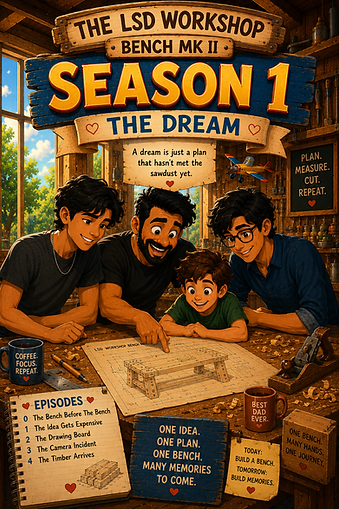
Every workbench starts as a sketch.
This one started as a question.
What do you build when the world feels uncertain?
For months, the idea of a second workbench sat quietly in the background. Then one day it stopped being an idea and became a commitment.
A timber yard.
An expensive camera.
A costly mistake.
An eight-year-old helper.
Two participants who unknowingly signed up for far more than a woodworking project.
Before a single joint was cut, the story had already begun.
Welcome to Season 1 of The LSD Workshop Bench Mk II.
Episodes 0–4
The Dream begins.

The funny thing about workbenches is that nobody really dreams about building one.
People dream about the things they'll build on it.
The cabinets.
The tables.
The toys.
The gifts.
The workbench is simply the thing that makes those dreams possible.
For years, my old workbench had served me faithfully. It had survived countless projects, endless modifications and the occasional moment where enthusiasm had greatly exceeded skill. It wasn't perfect, but it was mine. Every dent, scratch and stain had a story attached to it.
And yet, something was changing.
The workshop was no longer just a place where I worked.
People had started showing up.
Some came because they were curious about woodworking.
Some wanted to learn.
Some simply wanted to spend a day making something with their hands.
What had once been a solitary activity was slowly becoming something shared.
The problem was that one workbench only allows so many people to participate at the same time.
Whenever a class was running, tools and timber competed for space. Participants waited their turn. Projects shuffled awkwardly from one corner to another. The bench had become a bottleneck. I knew a second bench would help. I also knew that building one would require time, money and effort. So naturally, I avoided the decision for as long as possible. The idea sat quietly in the background for months. Possibly years. Every time I thought about building a second bench, another project seemed more important. There was always a reason to postpone it. Then Liam started spending more time in the workshop. At eight years old, he had already developed the remarkable ability to appear whenever something interesting was happening. If I carried timber upstairs, he appeared. If I started a machine, he appeared. If I was sweeping the floor, he somehow disappeared. Watching him move through the workshop changed something. For the first time, I found myself imagining two benches standing side by side. One for me. One for whoever happened to be learning beside me. Maybe a student. Maybe a friend. Maybe one day, Liam. The image was surprisingly difficult to ignore. Around the same time, the world felt increasingly uncertain. News reports arrived faster than solutions. Experts debated problems they couldn't solve. Predictions changed weekly. Everyone seemed worried about something. Including me. Eventually, I realised there was very little I could do about any of it. I couldn't influence wars. I couldn't influence economies. I couldn't influence politics. I couldn't even influence the weather over my own workshop. But I could build something. Woodworking has always felt like a small act of rebellion against uncertainty. A board is either square or it isn't. A joint either fits or it doesn't. The problems are visible. The solutions are measurable. And sometimes that is enough. One evening, while staring at a rough design on my computer screen, I stopped asking whether I should build a second workbench. Instead, I asked myself a different question. Why was I still avoiding it? I never found a particularly good answer. And that was the moment the project truly began. Not with timber. Not with tools. Not with drawings. With a decision. Somewhere between that decision and the first piece of timber, the LSD Workshop Bench Mk II quietly began its story. At the time, none of us knew that it would become far more than a workbench.
A good workbench can become an obstacle.
Not because it fails.
Because it succeeds.
My first workbench had served me exceptionally well.
It had survived projects, experiments, mistakes, redesigns and more than a few moments where enthusiasm had greatly exceeded skill. It wasn't perfect, but perfection was never part of the job description. A workbench exists to support work, and this one had done exactly that.
The irony was that the better it performed, the easier it became to postpone building a second one.
There was no emergency.
Nothing was broken.
No dramatic failure forced my hand.
Every time the idea of a second bench appeared, the existing one would quietly remind me that it was still perfectly capable of doing the job.
And so the idea lingered.
For years.
Like many decisions worth making, it didn't arrive as a lightning bolt. It arrived as a persistent thought that refused to leave.
Meanwhile, the workshop itself was changing.
When I first began woodworking, most of my projects were solitary affairs. It was just me, a collection of tools, some timber and an endless sequence of mistakes masquerading as lessons.

Over time, however, the workshop began attracting people. Participants. Students. Friends. Curious individuals who wanted to understand why anyone would willingly spend an entire afternoon trying to make two pieces of wood fit together with unreasonable precision. Teaching slowly became a larger part of what I did. And with every workshop, every one-on-one session and every project completed alongside someone else, the limitations of a single workbench became increasingly obvious. The bottlenecks were subtle at first. One person waiting while another completed a task. Tools competing for space. Projects being shuffled around because there simply wasn't enough room. A second bench wouldn't solve every problem. But it would remove many of them. Still, practical reasons alone weren't enough. Practical reasons rarely carry a project this large. The emotional reason arrived through a much smaller person. Liam. At eight years old, he had already become a familiar presence in the workshop. Sometimes he helped. Sometimes he asked questions. Sometimes he simply occupied the space while I worked. Like most children, he moved effortlessly between curiosity and distraction, often within the same minute. What mattered wasn't what he was doing. It was that he was there. One afternoon, while we were working side by side, I found myself imagining a future version of the workshop. Not a larger workshop. Not a better workshop. Simply a workshop with two benches. Two projects underway at the same time. Two people working side by side. Two generations sharing the same space. The image arrived unexpectedly. And once it appeared, it refused to leave. That was the moment things began changing. Until then the question had always been: "Should I build another workbench?" A perfectly reasonable question. A sensible question. The sort of question that allows endless postponement. Then, without warning, the question changed. It became: "Why am I still avoiding it?" The difference was subtle. But important. The first question asks whether something should happen. The second asks why it hasn't happened already. Once I reached that point, the decision was effectively made. The practical reasons were becoming overwhelming. The teaching side of the workshop was growing. Participants were becoming regulars. The space was evolving. And beneath all of those practical considerations sat a simpler truth. I wanted to build it. Not because I needed another project. Not because I needed another piece of furniture. But because I could already see what it represented. A place where future projects would begin. A place where skills would be learned. A place where mistakes would be made. A place where conversations would happen. A place where memories would accumulate. The second workbench stopped being a design. Stopped being a sketch. Stopped being an idea. It became a commitment. The bench itself still didn't exist. There was no timber. No joinery. No participants. No sawdust. No mistakes. Those would come later. But the most important step had already happened. The decision had been made. After years of postponement, rationalisation and avoidance, I had finally stopped asking whether I should build another workbench. And started planning how. The build had not yet begun. But the resistance had finally ended.

For most of my life, woodworking had been a fairly solitary activity.
That wasn't a complaint.
It was simply how things were.
My first serious workbench had been built that way.
Just me.
The tools.
The timber.
And a steady stream of mistakes.
Looking back, I learned a great deal from that experience. I also spent an impressive amount of time solving problems that could have been improved by another set of eyes.
By the time I started planning the LSD Workshop Bench Mk II, something had changed.
The workshop itself had changed.
What had once been a personal workspace had gradually become a place where other people came to learn, build and occasionally discover that woodworking was considerably harder than YouTube made it look.
I found myself asking a different question.
Not:
"How should I build this bench?"
But:
"What if the build itself became the workshop?"
Not a demonstration. Not a practice exercise. Not a carefully controlled project where participants assembled pre-made parts. A real build. With real consequences. Real mistakes. Real decisions. Real problem solving. And so, on the 22nd of April 2026, I put the idea out into the world. The proposal seemed straightforward enough. Build a workbench. Together. Learn. Build. Share. Have fun. What could possibly go wrong? The responses were fascinating. Some people assumed the workshop was free. Others loved the concept right up until the moment they realised participation involved actual work. It turns out there is a significant difference between liking the idea of woodworking and spending an entire day measuring, marking and correcting mistakes. Some disappeared immediately. Others disappeared more slowly. A few survived the screening process. Among the first was Yuvraj. I had met him earlier through one of my introductory woodworking sessions. What stood out wasn't his woodworking ability. At the time, there wasn't enough information available to make a meaningful judgement about that. What stood out was his curiosity. Questions arrived in rapid succession. Why this design? Could this joint be improved? What alternatives had been considered? What would happen if we changed the dimensions? Could a different approach work better? Every answer seemed to generate another question. From a teaching perspective, that was encouraging. Technical skills can be taught. Curiosity cannot. You can show someone how to sharpen a chisel. You cannot teach them to care why it should be sharp. Yuvraj cared. That mattered. Darsh entered the story differently. Most workshop participants arrive through woodworking. Darsh arrived through cameras. One day we were discussing photography, documentation and visual storytelling. The next day he was helping me think through a workbench build. Somewhere between those two events, he got recruited. I still can't identify the exact moment it happened. One conversation became several. Ideas turned into discussions. Discussions turned into planning. Planning turned into involvement. Before long, he was part of the project. If Yuvraj brought curiosity, Darsh brought observation. He noticed things. Not just woodworking details. People. Conversations. Moments. The story unfolding around the build interested him as much as the build itself. Looking back, that became more important than I realised at the time. Because the bench was never only about timber. It was also about the people standing around it. As April drew to a close, something unexpected happened. The project began changing shape. The design was still mine. The responsibility was still mine. The mistakes would certainly be mine. But the ownership was beginning to spread. Ideas were being discussed. Decisions were being questioned. Assumptions were being challenged. The project was becoming larger than a workbench. It was becoming an experience. And that realization brought a strange mixture of excitement and nervousness. Building a bench by yourself is relatively simple. If you make a mistake, you fix it. If you change your mind, nobody notices. If the schedule slips, the only person affected is you. Building alongside other people is different. Now there are expectations. Commitments. Responsibilities. The possibility of disappointing someone other than yourself. The bench still existed only as drawings and intentions. No timber had been purchased. No joinery had been cut. No sawdust had been created. But by the end of April, one thing was already clear. This had stopped being my project. It had become our project. And whether that was a brilliant idea or a terrible one remained to be seen.
Every project has a moment where confidence quietly transforms itself into overconfidence.
The problem is that the transformation is almost impossible to detect while it is happening.
At the time, it feels exactly the same.
The LSD Workshop Bench Mk II had not officially begun.
The participants had been recruited.
The design was largely settled.
The workshop dates were approaching.
Everything appeared to be moving in the right direction.
Naturally, this seemed like the perfect time to make an expensive mistake.
A few days earlier, I had been discussing cameras with Andre and Darsh.
The conversation started innocently enough.
Documentation.
Photography.
Video.
Ways to record the build properly.
The sort of conversation that begins with practical intentions and ends with online shopping.
Eventually I convinced myself that the project required an action camera.
Not wanted. Required. There is a significant difference. Wanted implies choice. Required implies justification. By the time I finished explaining the logic to myself, I was entirely convinced. A camera was purchased. The camera arrived. I was delighted. I opened the box with the enthusiasm usually reserved for new tools. Buttons were pressed. Menus were explored. Settings were adjusted. For several hours, everything felt entirely sensible. Then I looked at the receipt. The hole in my wallet was still fresh when I made my next decision. Unfortunately, the next decision would prove considerably more expensive. On the afternoon of the 29th of April 2026, I picked Liam up after school and headed to Hanuman's timber yard. The mission felt straightforward. Purchase the timber. Bring it home. Begin preparing for the build. Simple. At least in theory. By this point I had a design. I had measurements. I had participants lined up. I had confidence. Far too much confidence, as it turned out. Liam, meanwhile, was simply excited to be part of the adventure. Timber yards possess a certain magic when viewed through the eyes of an eight-year-old. Stacks of wood become towers. Forklifts become entertainment. Offcuts become treasure. Every pile appears to contain possibility. Together we walked through the yard discussing dimensions, stock and suitability. Eventually I selected the timber. Paid for it. Loaded it. Transported it home. The entire operation appeared to be a success. I remember feeling unusually pleased with myself. Everything seemed under control. The design was progressing. The participants were committed. The timber was purchased. The project was moving forward. Mission accomplished. The following morning I carried the timber up to the workshop. Board after board. Trip after trip. By the time everything was finally stacked inside the studio, I was hot, tired and ready to admire my accomplishment. Then something looked wrong. At first I couldn't identify it. The feeling arrived before the explanation. I glanced across the workshop toward my existing workbench. Looked at its legs. Then looked back at the newly purchased timber. Then back at the bench. Then back at the timber. A slow and unpleasant realization began forming. The stock was too small. I measured it. Measured again. Measured the plans. Measured the bench. Measured everything a third time in the hope that mathematics might have developed sympathy overnight. It had not. The timber was wrong. Not slightly wrong. Not technically wrong. Completely wrong. I had purchased undersized stock for critical components of the build. The mistake wasn't caused by lack of information. The dimensions were available. The drawings existed. The measurements were known. The mistake was caused by something much more dangerous. Assumption. I had stopped checking. I thought I knew. The bench had drawn first blood before a single joint had been cut. For a few minutes I was furious with myself. Every woodworker knows this feeling. The mistake is obvious. The solution is obvious. The only thing missing is a convincing explanation for why you created the problem in the first place. Eventually the frustration faded. Embarrassment replaced it. Then perspective arrived. The timber could be replaced. The project wasn't ruined. The only permanent damage was to my ego. The following day I returned to the timber yard and purchased the correct stock. The mistake cost money. It cost time. It cost pride. In hindsight, it may have been one of the most valuable moments in the entire project. Because before a single participant arrived, the workbench had already taught its first lesson. Timber doesn't care how confident you are. It doesn't care how experienced you are. It doesn't care how many SketchUp models you've drawn. It only cares about dimensions. Around the same time, Darsh was becoming increasingly involved in the project. His route into the workshop remained unusual. Most people arrive because they are interested in woodworking. Darsh arrived because of cameras. One day we were discussing photography. The next day he was helping me think through a workbench build. Somewhere between those two events he became part of the team. Like most good recruitments, nobody could identify the exact moment it happened. By the end of April, the project had acquired a camera, the wrong timber, the right timber and a growing collection of people invested in the outcome. More importantly, something else had changed. The workbench no longer belonged entirely to me. The design may have started in my head. But the story was no longer mine alone. I wasn't simply building a workbench anymore. I was building an experience. And experiences, unlike workbenches, are rarely built alone.


If the first lesson of the project was humility, the second was endurance.
The wrong timber had been returned.
The correct timber had been purchased.
The embarrassment had mostly subsided.
Now there was only one problem.
The timber was downstairs.
The workshop was upstairs.
A great deal of woodworking consists of moving wood from one place to another while pretending that isn't what you're doing.
The LSD Workshop Bench Mk II was no exception.
The workshop occupies a roofed terrace above our home.
Which sounds charming until you begin carrying hardwood up flights of stairs in the middle of a Mumbai summer.
Then it becomes exercise.
Very specific exercise.
The kind of exercise that nobody voluntarily pays for.
Board after board.
Trip after trip.
Upstairs.
Downstairs.
Repeat.
The timber seemed determined to test both my patience and my cardiovascular system. Every load delivered to the workshop revealed another waiting downstairs. The process felt endless. Meanwhile, Liam treated the entire operation as an adventure. The difference between being eight years old and being an adult can often be measured by how much excitement you find in carrying pieces of wood. To Liam, every board represented possibility. To me, every board represented another trip up the stairs. Together we slowly relocated the future workbench from the ground floor to the terrace. By the time the last board arrived, Mumbai had decided to contribute its own opinion. The heat arrived with enthusiasm. Mumbai summers do not merely test timber. They test people. The workshop sat beneath its metal roof collecting sunlight with impressive efficiency. By midday the space had become less of a woodworking studio and more of an experiment in human resilience. Sweat became a permanent condition. Hydration became a strategy. Work happened in short bursts separated by water breaks and negotiations with reality. At one point I remember sitting beside a stack of timber wondering whether perspiration could be classified as a woodworking technique. Liam, meanwhile, approached the challenge with considerably greater wisdom. Drink water. Rest. Drink more water. Repeat. Simple. Effective. Possibly genius. The timber needed to be prepared. Boards had to be checked. Stock had to be organised. Dimensions needed confirmation. The project still hadn't officially begun, but there was plenty of work to do. Preparation rarely makes exciting photographs. It rarely becomes the highlight of a project. Yet every successful build rests upon hundreds of small, unremarkable decisions made before anyone notices. Most of that week consisted of exactly those decisions. Measurements. Organisation. Material preparation. The sort of work that quietly determines whether future weekends become productive or painful. What I remember most, however, isn't the timber. It isn't the heat. It isn't even the endless staircase. It's Liam. At some point he unofficially appointed himself head of workshop maintenance. Nobody offered him the position. Nobody conducted interviews. Nobody reviewed qualifications. He simply decided the role belonged to him. And then performed it with remarkable seriousness. Every session ended the same way. Tools returned. Offcuts gathered. Sawdust swept. Order restored. He approached cleanup with a level of enthusiasm that many professional woodworkers never achieve. Watching him work was strangely satisfying. Partly because the help was genuinely useful. Partly because every parent recognises those moments when a child begins taking ownership of something. The workshop was becoming familiar territory. Not just mine. His too. As a woodworker, I appreciated the assistance. As a father, I appreciated the company. Looking back, many of my favourite memories from that week have very little to do with woodworking. There were no complicated joints. No dramatic breakthroughs. No major accomplishments. Just shared time. Conversations. Small routines. And the quiet satisfaction of working alongside someone you care about. By the first week of May, the timber was finally dimensioned and organised. The workshop was ready. The participants were ready. The project was ready. Most importantly, a date had been set. Saturday, the 9th of May, 2026. The build would officially begin. For weeks the workbench had existed only as drawings, conversations and intentions. Now it was becoming real. The timber sat waiting in neat stacks. The plans were prepared. The tools were ready. The participants would soon arrive. The long preparation phase was over. The real work was about to begin. Before heading downstairs that evening, Liam and I stood together on the terrace looking across the city. The timber was finally where it needed to be. The workshop felt ready. So did we. I thanked him for the help. He grinned. The kind of grin only an eight-year-old can produce. The grin of someone convinced that the best part is still ahead. For once, I agreed. Next weekend, we would begin building a workbench. Or so we thought. In reality, we were about to start building something much larger than that.